 Airswap
 RFQ lets clients review maker-signed orders before on-chain settlement
UpdatedAirswap RFQ lets a client request a maker-signed token order, inspect its terms, and submit it for atomic on-chain settlement. A signed order is an offer with an expiry. Completion requires successful execution by the matching settlement contract, with valid permissions, sufficient balances, and the correct signature.
Establish the network and maker configuration
A request-for-quote session needs a maker that supports the intended protocol, network, settlement contract, and tokens. These details establish the exchange that the maker can quote. They do not establish that a particular order will execute. A token symbol alone leaves the token contract unidentified. The discovery method
getProtocols
exposes supported protocol configurations, including the chain ID, swap contract address, and maker wallet. Keep these consistent with the request and wallet network. The client requests an order for that configuration through the maker's JSON-RPC server over HTTPS or WebSocket. Reviewing the reply does not itself transfer tokens or require submitting a swap.
Translate signer and sender into the proposed exchange
In RFQ, the maker signs the order, and the client sends it for settlement. Consequently,
signerToken
and
signerAmount
describe what the maker supplies.
senderToken
and
senderAmount
describe what the client supplies. The method names follow these protocol roles, which can feel reversed when reading from a buying interface.
The order expresses token quantities in atomic units, using each token's decimal precision. Compare displayed quantities only after the application converts those units correctly. A wallet-specific signature also commits to the sender wallet. Token compatibility and the settlement contract's order format remain prerequisites; a familiar ticker cannot establish either one.
Should the request fix the amount sold or received?
Fix the selling amount when spending is the constraint; fix the receiving amount when the intended output is the constraint. Both RFQ request directions return maker-signed orders. The difference is which amount the request supplies and which amount the maker calculates.
Fix the amount to sell
getSignerSideOrderERC20
takes
senderAmount
and returns the corresponding
signerAmount
. The client specifies the amount it will provide and asks the maker to price the other side. Compare returned receiving amounts only across requests that hold the selling amount and configuration constant.
Fix the amount to receive
getSenderSideOrderERC20
takes
signerAmount
and returns
senderAmount
. The client specifies what it wants from the maker, which quotes the required payment. Different makers may quote different payment amounts.
Distinguish soft pricing from a signed order
A pricing response can describe indicative pricing through levels or a formula, while an RFQ order contains signed exchange terms.
The signed order identifies the token amounts, expiry, and nonce, together with the signature information. Its signing domain binds the authorization to the relevant chain and verifying contract. Copying the displayed rate into different order fields does not preserve the maker's authorization.
Receiving that order leaves settlement unexecuted. The client can decline the terms before submitting a transaction. Existing approvals, if any, remain separate permissions.
Changing the pair, amount, sender restriction, or settlement configuration requires an order that authorizes the changed terms. A new request may return different pricing. Retaining the original display while changing the underlying request would misrepresent which exchange the signature actually covers.
Prepare allowances without confusing them with signatures
Token allowances permit the settlement contract to transfer tokens, while the maker's signature authorizes the order terms. Both parties need sufficient balances and applicable allowances for the selected execution method. An approval for another contract does not give this settlement contract permission to spend.
The client's readiness concerns its payment token and, when it submits an Ethereum transaction, ETH for gas. Maker readiness concerns the tokens it must deliver and any additional protocol fee. An authorized signatory may sign for the maker wallet; that authorization does not replace the wallet's token allowance. None of these checks reserve balances against subsequent spending.
The
swapLight
path is intended for known tokens. It still validates the signature, expiry, and nonce. Those order checks do not establish that an arbitrary token implements the expected transfer behavior. Token behavior therefore matters before choosing the execution method.
Keep settlement fees separate from gas
Method-specific protocol fees
SwapERC20 signing-domain version 4.3 distinguishes
protocolFee
for
swap
from
protocolFeeLight
for
swapLight
. Each method checks a signature that includes its applicable fee setting. Reusing an order across methods requires matching signing terms; the method names alone do not establish compatibility.
The protocol fee uses the maker's
signerAmount
as its base and charges the maker in
signerToken
. Multiply that amount by the applicable basis-point setting and divide by 10,000, with integer truncation. For
swap
, the sender's balance of a configured staking token determines any bonus from this fee. A positive bonus goes to the transaction sender, with the remainder going to the fee wallet. Without a positive bonus, the full fee goes to the fee wallet. This distribution does not change the maker's fee base.
The submitting wallet pays network gas
An Ethereum transaction consumes gas even when its execution reverts. Gas is separate from the token-denominated protocol fee. Approval transactions can also consume gas. An exact exchange amount therefore describes the token trade without establishing the transaction's total cost.
Follow an input-sized RFQ through to settlement
Assume a hypothetical first session with a selected ERC-20 pair, client wallet, maker, settlement deployment, and selling amount
S
. All these selections are hypothetical; no live amount or quote is implied. The client wants to keep its selling amount fixed while comparing the two request directions.
A signer-side request supplies
senderAmount = S
; the maker returns the receiving amount. A sender-side request instead fixes the receiving amount and asks for the payment. Only the first direction directly expresses this session's spending constraint. The returned order must show
senderAmount = S
before its other terms can satisfy that request.
Assume the client accepts that order and both parties have the required balances and allowances. The client submits the matching settlement transaction before expiry. A successful receipt containing the matching
SwapERC20
event establishes execution; the transaction's token transfers show the exchange that occurred. The signature authorizes the order; the submitted transaction hash identifies the transaction without confirming execution.
If execution reaches the order's expiry or encounters a used nonce, the contract rejects the order. The fixed selling amount does not override those conditions. Before submission, the client can stop by declining the order; after submission, its transaction status determines whether any swap actually executed.
Expiry follows the execution timestamp
An order's
expiry
is an absolute timestamp, expressed in seconds since 1 January 1970. It describes the settlement boundary, not a universal quote lifetime. Request latency and transaction inclusion consume part of the interval that remains before that boundary.
SwapERC20 signing-domain version 4.3 rejects settlement when the block timestamp is equal to or greater than the order's expiry. Submitting a transaction beforehand does not establish that execution will occur beforehand. Signature validity also depends on the applicable fee setting and authorization, while nonce status can change independently of expiry.
Read failures at the layer that produced them
A maker returns a request error
A JSON-RPC error means the maker did not return the requested order. It differs from a settlement revert. The error message can identify a pair, amount, or parameter issue, so interpret it before changing the request. A server response does not establish an on-chain failure.
The contract rejects authorization
A signature failure can reflect mismatched order fields, signing-domain details, or the method's fee setting. A consumed or cancelled nonce prevents reuse within that deployment's signatory state on the selected network. Altering a signature field cannot repair a maker authorization that covers different terms.
A token transfer cannot complete
A balance or allowance shortfall can arise after an order arrives. Token transfer restrictions can also block execution. These failures concern settlement readiness. Repeating the same submission does not replenish balances, grant allowances, or change the token's transfer rules.
What confirms that the RFQ swap completed?
A successful settlement transaction containing the matching swap event confirms execution, while a quote response or pending transaction does not. Match the receipt to the intended network, settlement contract, maker, and nonce. Inspect the token transfers for the actual movement of funds.
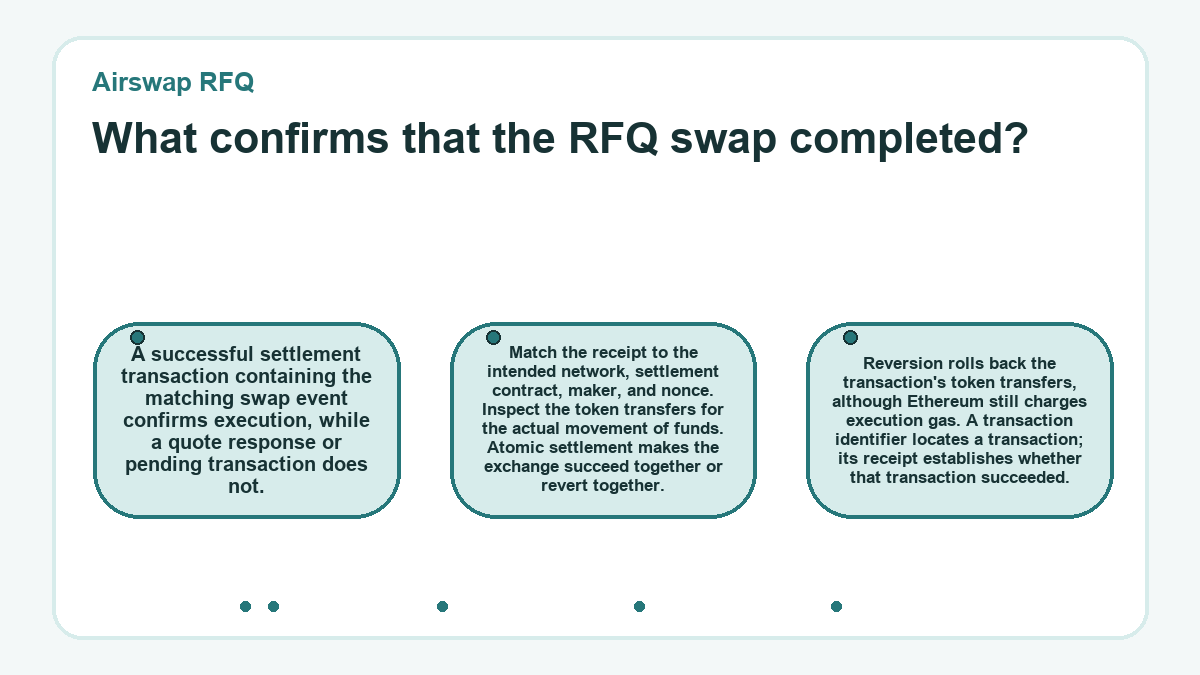
Atomic settlement makes the exchange succeed together or revert together. Reversion rolls back the transaction's token transfers, although Ethereum still charges execution gas. A transaction identifier locates a transaction; its receipt establishes whether that transaction succeeded.
LastLook uses the opposite signing roles
LastLook gives the client the signing role and the maker the submission role. The maker streams prices and decides whether to settle the client's signed order. Its effectively gasless client settlement applies to that arrangement; it does not describe the client-submitted RFQ sequence.
A WebSocket connection alone does not identify the trading protocol because a server can support both RFQ and LastLook. Read the advertised protocol and signing roles together. That distinction determines whether the next authorization comes from the maker or the client, and which party submits the settlement transaction.
Airswap RFQ questions, answered
Can an RFQ order send the purchased tokens to another recipient?
SwapERC20 signing-domain version 4.3 exposes a recipient parameter in its swap and swapAnySender methods. Those methods send the maker's quoted token amount to that recipient. The swapLight method sends that amount to the transaction sender instead. An application's interface determines which supported method and recipient controls it exposes; the contract capability does not establish that every interface offers that choice.
Does a wallet-specific RFQ signature also work with swapAnySender?
A wallet-specific signature does not automatically authorize swapAnySender. In SwapERC20 signing-domain version 4.3, swapAnySender validates an order whose signed sender address is the zero address. A signature that commits to a particular sender has different terms. The maker must authorize the any-sender form; changing the submitted sender field cannot convert the existing authorization.
Is the RFQ request ID the same as the order nonce?
The JSON-RPC request ID and the order nonce identify different objects. The request ID associates a server reply with a request. The nonce belongs to the signed order and supports settlement replay protection. Tracking a successful request therefore does not establish a completed trade. Settlement records must match the relevant order and contract.
Can I request a minimum expiry from an RFQ maker?
The ERC-20 RFQ request methods accept an optional minExpiry parameter expressed in seconds. It asks the maker for a minimum expiry when preparing the order. Inspect the expiry that the returned order actually contains. The request does not guarantee transaction inclusion, and independent validity conditions can prevent settlement before the timestamp arrives.
What does error -33605 mean when requesting a quote?
Error -33605 identifies a maker-side rate limit. It concerns request handling, so it does not report an executed or reverted swap. The code does not establish a universal waiting period or request allowance. Any retry timing must follow information that the particular server supplies; changing token approvals cannot remove a server-side request limit.
Will a newer RFQ quote cancel the maker's earlier order?
A newer quote does not automatically cancel an earlier signed order on-chain. An earlier order can remain usable while its expiry, nonce, signature, balances, and permissions remain valid. Settlement or cancellation can consume its nonce. Orders that share the same signatory and nonce in the same settlement deployment on the same network share that replay-protection state, even if their quoted terms differ.